
Why talented designers get overlooked
You’ve seen it happen. Maybe it’s happened to you.
A hiring manager is reviewing your portfolio...
They search for why you landed on the final design. They can't find it, and close your portfolio.
You make it to the presentation interview round...
They ask about your process. You explain what you did but stumble when they ask why. Another candidate gets the offer.
You present a design to stakeholder...
It's solid work. But when they ask "Why not try X instead?" You struggle to defend your solution. They go with the one you don't want.
You want to move from mid-level to senior...
But senior designers influence strategy, push back on bad requests, and speak the language of business. You're still waiting to be told what to design.
Interview ready
Answer “why” without freezing. Explain clearly, quickly, & confidently.
Stakeholder proof
Push back with research + business impact, not just "UX Speak"
Senior signals
Show strategic thinking, trade-offs, constraints, and outcomes.
This challenge is what I wish I'd had 10+ years ago. Universities & bootcamps don't touch these skills, mine included. I've learned the hard way that this is what actually matters for your design career. These aren't course videos you have on in the background; they're design prompts that reflect real work scenarios. I believe real learning happens by doing, and that's how you take these skills into your actual day-to-day.




Where design education
leaves gaps
Design education focuses on craft, not communication.
You spent years learning:

Visual hierarchy and typography
User research and wireframing
Prototyping and usability testing
Personas & user flows
Design systems and accessibility
But you were never taught:

How to present 3 options and guide stakeholders to the best one
How to push back on a bad feature request without burning bridges
How to connect design decisions to business metrics
How to turn messy research into a compelling argument
How to defend a choice when you didn't have time for user testing
These communication skills separate designers who advance from designers who plateau.
Week 1
First Impressions & Fast Exits
This week is about using data to drive design decisions and balancing user frustration with business goals.
What you’ll practice
Using research insights to inform design decisions
Balancing user needs with business objectives
Articulating the "why" behind every change you make
The problem
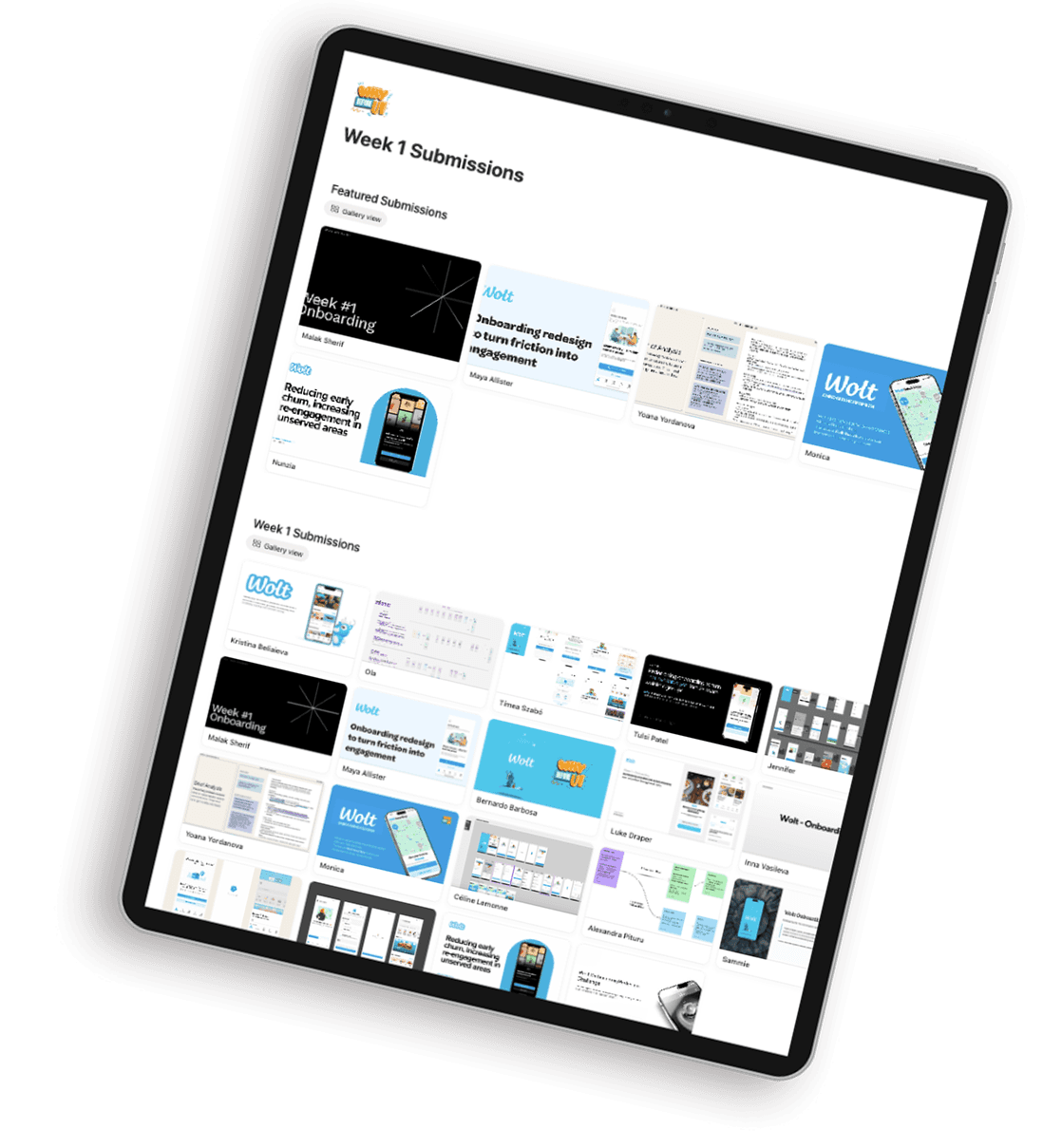
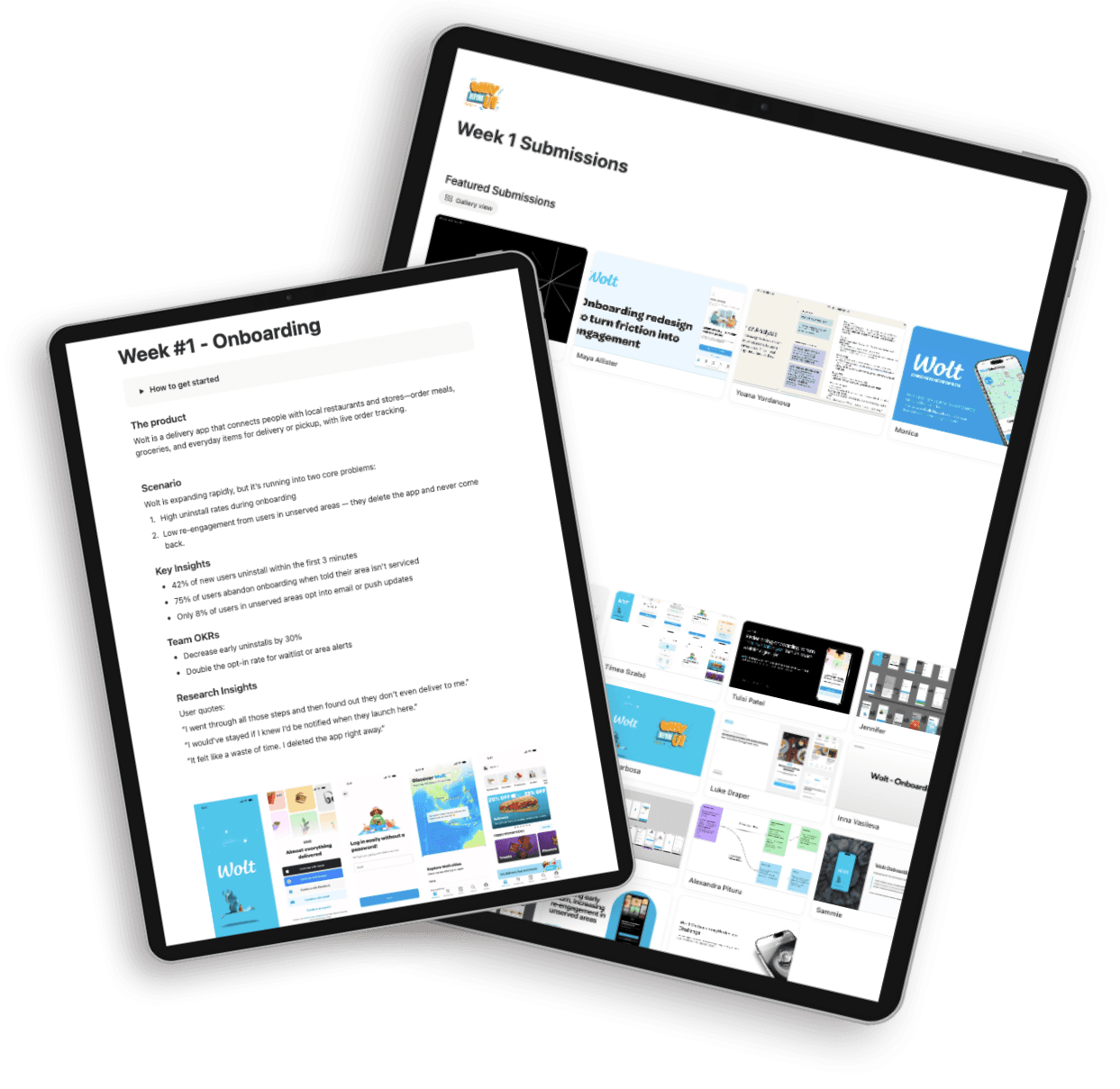
New users are uninstalling almost immediately, especially when they discover their area isn't serviced.
Your Job
Redesign the onboarding experience using research insights to inform your decisions, then explain what you changed, why you made those choices, and what impact you expect.
Testimonial
"I realized how much I’ve missed diving deep into the problem space and shaping product strategy—something I haven’t been able to do much of in my day job lately. It reminded me how much I value that kind of thinking."

Jennifer
Sr. Product Designer, 8 years experience
Week 2
Shipping Less to Learn More
This week is about understanding scope—the difference between validation and execution, and knowing when to say "not yet."
What you’ll practice
Defining scope for validation vs. execution
Understanding the difference between MVP and full feature sets
Identifying potential complexity before it derails development
The problem
The team wants to increase shares and social referral traffic, but building a full feature could introduce unnecessary complexity.
Your Job
Define what's "just enough" to test with users, identify the assumptions you're making about behavior, and consider where this might introduce complexity.
Testimonial
"I learned how valuable it is to slow down and question the assumptions hidden in the brief. Mapping the "why" before jumping into interface solutions helped me turn abstract goals into measurable hypotheses and that clarity changed how I design, not just what I design"

Marta C
UX Advisor, 8 years experience
Week 3
Constraints as Creative Fuel
This week is about designing for real stakeholders with real opinions—and presenting your rationale in ways that build confidence.
What you’ll practice
Working within client constraints while solving real problems
Balancing storytelling with conversion-focused design
Presenting rationale in ways that build stakeholder confidence
The problem
A real non-profit with an outdated website is struggling with flat donations and high mobile bounce rates.
Your Job
Balance storytelling with conversion, work within client constraints, and explain how your design addresses their goals without losing their voice.
Testimonial
"I’ve mostly designed for businesses, so this prompt made me step back and think about how to design for a cause-driven experience, balancing emotion, storytelling, and conversion at the same time."

Rimsha
UX/UI Designer, 2-4 years experience
Week 4
Innovation with AI
This week is about competitive strategy and emerging tech—integrating AI thoughtfully, not reactively, while maintaining product identity.
What you’ll practice
Competitive analysis (direct and indirect)
Integrating emerging tech thoughtfully, not reactively
Maintaining product identity while evolving capabilities
The problem
AI-first competitors are gaining ground while users value simplicity above all else.
Your Job
Research what AI enables, analyze competitors, and design a focused feature that reduces friction without increasing complexity.
Testimonial
"One thing I learned about considering/using AI - AI isn't a solution itself, it's a means to a solution."

Inna Vasileva
Software Engineer/UX Designer, 2-4 years experience
This is NOT For You If...
You're a complete beginner (you need UX fundamentals first)
You only want visual execution practice (this is about rationale, not craft)
You think talent alone should be enough to advance
You're unwilling to do the hand-on practice it takes to learn these skills
This Is For You If...
You struggle to explain "why" when stakeholders or interviewers ask
You want your portfolio to show decision-making, not just deliverables
You're building toward senior roles and need to close your skill gaps
You know craft alone isn't enough—you need communication to match
The Challenge
4 Week
Design Challenge
€79
Develop the ability to tie your work to business impact, articulate your rationale, and win your stakeholders over with confidence.
Get Week 1 Now →
Enroll in 2 minutes · Get Week 1 Immediately
What's included

4 Weeks of Real Business Scenarios
Practice navigating the exact situations experienced designers face
10-20 Designer Case Studies Per Prompt
See how other designers defended the same decisions. Learn what makes explanations compelling vs weak.
Reflection Prompts to Sharpen Your Thinking
Self-guided questions that help your learning actually stick.
Self-Paced: 3-4 Hours Per Prompt
Fits into your schedule. Lifetime access, revisit anytime.
What Changes
Your portfolio demonstrates strategic thinking, not just execution
You defend designs with clarity, not hesitation
You speak business language, not just design jargon
You're seen as a strategic thinker, not just a pixel-pusher
Before
In interviews:
"I designed this because it felt more intuitive." Hiring manager: "Can you be more specific?"
With stakeholders:
"I think Option B is better."
PM: "Why? Can we see other options?"
In your portfolio:
Shows final mockups. No explanation of constraints, trade-offs, or decision-making.
After Why Before UI
In interviews:
"I chose this approach because it addresses the top three pain points from research—while staying within technical constraints. It reduces drop-off and increases task completion."
Hiring manager: "That's exactly the thinking we need."
With stakeholders:
"Option B balances user needs with business goals. Here's why. Option A prioritizes speed but sacrifices retention. Option C requires too much dev time for unclear ROI."
PM: "Let's move forward with B."
In your portfolio:
Shows decision-making process. Explains trade-offs, constraints, and why this solution was the right call.


What designers are saying










Articulate your rationale, connect decisions to business impact, and defend your work under pressure.
You already have the craft.
Now build the communication skills to match.
Built by Designers for Designers
#ChallengeArchitects









Still have questions?
Contact me anytime